
Three Kentucky Record Custodians
Kentucky divides marriage and divorce records among three custodians. A separately elected county clerk issues a marriage license and records the completed return after the ceremony. The Circuit Court Clerk in the filing county keeps the divorce petition, docket, signed decree, and related Family Court orders. The Kentucky Office of Vital Statistics, or OVS, searches a statewide certificate index for marriage and divorce events from June 1958 forward. These products are not interchangeable. A vital certificate proves that an event was registered, while the county record supplies the original license or full court document.
Quick Reference:
New or original marriage license: County clerk in the issuing county.
Certified marriage certificate: OVS for June 1958 forward, or the issuing county clerk.
Divorce decree or case file: Circuit Court Clerk in the filing county.
Certified divorce certificate: OVS for June 1958 forward.
| Record | Original Issuing / Filing Office | Certified Copy Source |
|---|---|---|
| Marriage license and return | County clerk where issued | Issuing county clerk |
| Marriage certificate | County record reported to OVS | OVS or issuing county clerk |
| Divorce petition and case file | Circuit or Family Court | Circuit Court Clerk in filing county |
| Divorce proof | Circuit Court decree reported to OVS | OVS certificate or clerk-certified decree |
Kentucky Marriage License Rules
Both applicants generally apply together at a Kentucky county clerk's office. They should check current office hours, appointment practices, accepted identification, age documents, and the exact local charge before arriving. Kentucky has no ordinary waiting period, and a license is generally valid for 30 days. Applicants should confirm both points with the issuing clerk because the license must remain valid when the ceremony occurs. Adults age 18 or older do not need parental consent. A 17-year-old follows a court-permission process using judiciary forms AOC-202 and AOC-203; younger people are not processed as ordinary adult applicants.
Kentucky does not create a common-law marriage merely through cohabitation. It may recognize a marriage validly created elsewhere, which is a different legal question. Prior marital status must be stated truthfully, and a clerk may ask for information about how an earlier marriage ended. The recorded license is not complete until an authorized officiant performs the ceremony, completes the return, and sends it to the issuing county clerk.
Note: Confirm local hours and payment before visiting because a statewide marriage rule does not fix each county clerk's daily procedure.
Apply for a Kentucky License
Prepare before visiting because local hours, payment methods, and appointment rules can differ. The statewide process follows the same basic sequence.
- Choose a Kentucky county clerk and confirm the office's current identification, age-document, scheduling, and payment rules.
- Both applicants complete the application and disclose names, birth facts, current marital status, and prior marriages.
- Review every entry and pay the county's current license total. Ask the clerk to confirm expiration and return instructions.
- Have a legally authorized officiant conduct the ceremony while the license remains valid.
- The officiant completes and returns the license. Confirm that the issuing clerk recorded it before ordering proof.
The Kentucky county directory routes applicants to the proper local office. A marriage performed without a recorded return can cause later proof problems, so checking the completed record is a sound final step.
Kentucky Marriage Application Fields
The application collects more than names and ages. Kentucky's official procedural inventory includes identity, family, status, and ceremony facts for each party. Sensitive values such as Social Security numbers may be collected under law but should not be republished from a record.
| Field | Required | Notes |
|---|---|---|
| Name, address, birth date, and age | Yes | Use current legal and identity information. |
| Birthplace and parents' names | Yes | Includes mother's first and maiden name. |
| Marital status and prior marriages | Yes | Single, divorced, annulled, or widowed; number of prior marriages. |
| Occupation, race, and relatedness | Yes | Kentucky bars marriage between first and second cousins. |
| Residence and Social Security number | Collected | Sensitive values are not public display fields. |
| Intended ceremony facts and signatures | Yes | County forms capture place, date, and applicant signatures. |
Note: A field collected on the application is not automatically a field that Kentucky permits the public to view without redaction.
Kentucky Marriage and Divorce Fees
The researched sources do not support one fixed statewide checkout total for every product. County marriage-license totals vary, while court filing, certification, postage, card, and local facility costs can change the amount due. OVS charges for a certificate search and keeps the search fee even when no certificate is located. Confirm current charges and payment methods with the actual custodian before sending money.
| Item | Amount | Where Paid |
|---|---|---|
| Marriage license | Confirm current county total | County clerk |
| OVS marriage or divorce certificate | Confirm current form or purchase page | Office of Vital Statistics |
| Divorce case filing | County total varies | Circuit Court Clerk |
| Plain or certified decree copy | Confirm pages and certification | Circuit Court Clerk |
Note: Ask the receiving agency which certified product it needs before paying for a certificate, license copy, or divorce decree.
Search Kentucky Marriage Records
For a June 1958 or later event, submit a paid application to OVS with both parties' full names at the time of marriage, the event date, and the issuing county. OVS does not provide a free telephone verification or genealogy search. If a matching certificate is on file, the office mails a certified copy. For an original license, completed return, or older record, contact the county clerk that issued it. When the ceremony city is known but the issuing county is not, personal papers and the officiant may help identify the right clerk.
Older Kentucky marriage records may have moved from the clerk to archival custody. Start with the county office, then follow its locator instructions for the Kentucky Department for Libraries and Archives or another named repository. An online no-result does not prove that no marriage occurred.
Search Kentucky Divorce Records
Kentucky dissolution cases are filed in Circuit Court or its Family Court division. Guest CourtNet can help locate a case by county and party name, but the Circuit Court Clerk holds the official file. Ask for the signed decree when proof of termination is required, and state whether certification is needed. A docket, decree, findings, settlement, and OVS certificate each answer a different question. The certificate registers the event; it does not reproduce the court's custody, support, debt, or property rulings.
A divorce file may include the petition, summons or waiver, verified disclosures, parenting and support material, property agreements, orders, and decree. Adoption matters, protected addresses, minor identifiers, financial accounts, health information, and sealed exhibits can be restricted even when the docket or decree is public. Search with names used at filing, including a maiden or prior name, plus the filing county and approximate year.
The official OVS page is represented in the Kentucky marriage and divorce certificate source below.
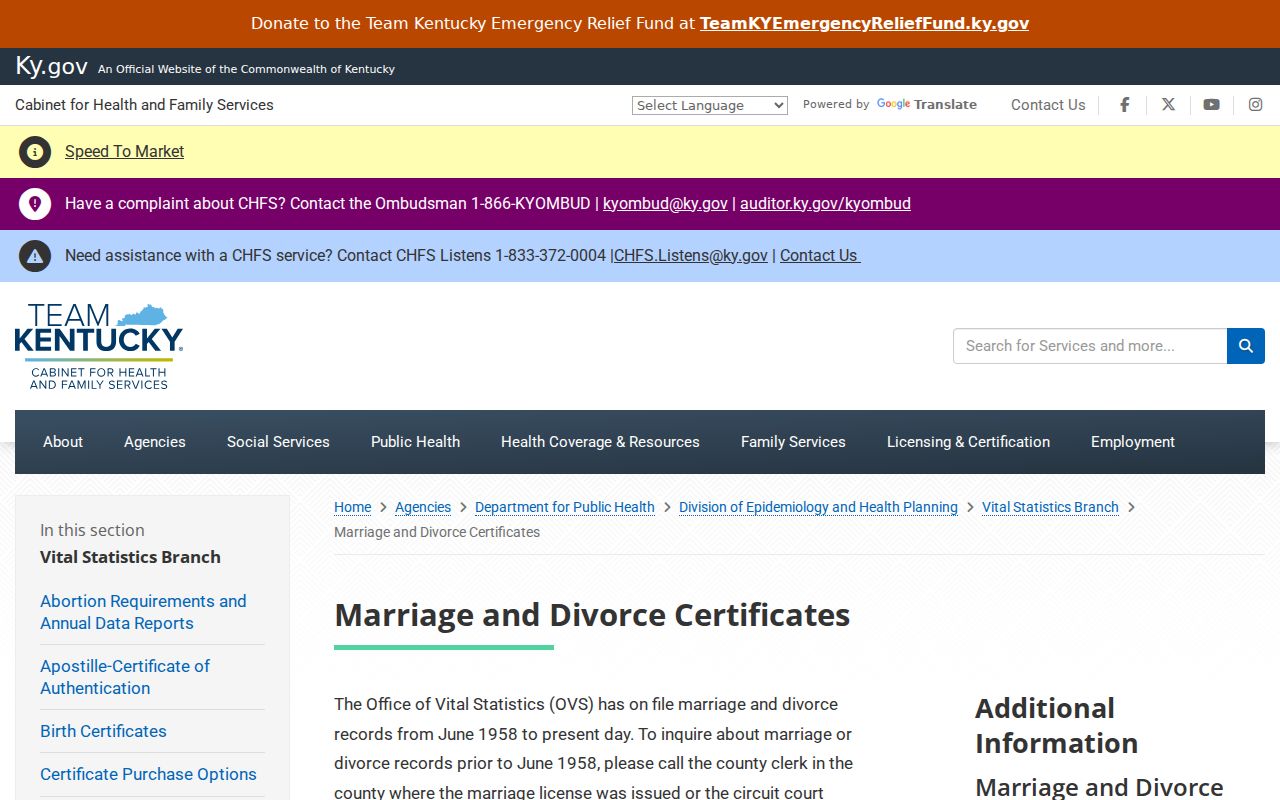
The state source confirms the certificate route, while original licenses and full divorce files remain with their county custodians.
Note: A public divorce docket can coexist with restricted financial, child-related, medical, address, or account information in the case file.
Kentucky Certified Record Choices
Ask the receiving agency what proof it requires before ordering. Immigration, pension, remarriage, name-change, estate, and foreign-use matters may demand a specific certified or authenticated product. A county clerk can certify the recorded marriage license and return. A Circuit Court Clerk can certify the divorce decree. OVS can certify a registered event from its modern index. Certification confirms that the copy comes from the custodian's record; it does not make every statement in an underlying filing true.
- Identify whether the recipient wants a state certificate, recorded marriage license, signed decree, or full case file.
- Gather event names, date, county, case or license number, requester contact, and delivery address.
- Use OVS for a modern certificate or contact the correct county custodian for the original document.
- Confirm the current search, copy, certification, postage, and payment requirements before submitting.
Kentucky Vital Records Certificates
The Kentucky Cabinet for Health and Family Services, Office of Vital Statistics maintains the statewide marriage and divorce certificate index from June 1958 forward. Use the official marriage and divorce page and the VS-230 certificate application. The form asks for certificate type, both parties' event names, event date, county, number of copies, requester contact and mailing information, signature, and payment details. The fee pays for a search and is retained if no record is found.
OVS supplies the registered certificate, not free status verification or a complete divorce litigation packet. The office's ordering instructions should be checked for current online, mail, phone, and in-person channels. For a record before June 1958, begin with the marriage county clerk or the divorce county Circuit Court Clerk.
Certificate or original? OVS supplies a certified event certificate. The county clerk supplies the recorded marriage license, and the Circuit Court Clerk supplies the divorce decree or case file.
Kentucky Office of Vital Statistics
Statewide certificates from June 1958 forward
Use the official application and current purchase instructions
Find Kentucky Marriage Records Locally
Every Kentucky county has a county clerk for marriage licenses and a separate Circuit Court Clerk for divorce cases. Use the full directory of all 120 Kentucky counties to reach the local site, then confirm that the selected office holds the requested product. For older or archived files, start with that custodian and obtain any case, record-series, or file-locator number needed for retrieval.