
Search Kentucky Court Records Statewide
Guest CourtNet through KYeCourts provides statewide case information for Circuit, Family, and District Court matters entered by clerks in all 120 counties. It is a locator and event-search tool, not the certified record. Results can lag, omit protected images, or exclude sealed cases. Guest terms also bar use as an employment, licensing, or government-benefit background check. Once a result identifies the county and complete case number, the Circuit Court Clerk in that county supplies the official docket and documents.
Prepare the legal name used when the case was filed, spelling variants, the likely county, an approximate year, and any paper case or citation number. Kentucky case numbers usually combine the filing year, a case-type code, and a sequence. A felony can have an early District Court F number and a later Circuit Court CR number. Search a likely county first, compare party roles and dates, then expand only when venue or transfer remains uncertain. A matching name alone does not establish identity.
- Open Guest CourtNet and proceed through the public guest login and displayed terms.
- Select a county when known and enter a last name, case number, or court-date range.
- Compare the county, court, type, parties, filing date, and status with known facts.
- Record the full number and use the Kentucky county directory to reach the filing county.
- Ask the Circuit Court Clerk for the exact pleading, order, docket, recording, transcript, or certified copy needed.
The judiciary's official court-record request instructions explain that AOC does not keep county trial files. A failed online search can mean restricted access, delayed entry, an archive, a transfer, or lawful destruction under a retention schedule. It does not prove that no Kentucky court record exists.
Kentucky Court Records Search Fields
Guest CourtNet offers more than a broad name box. County, name, case number, case type, and date criteria help narrow Kentucky court records. Public visibility can differ from attorney, party, agency, or subscriber access, especially for dates of birth and document images. These fields reflect the statewide guest workflow inspected in the research.
| Field Label | Type | Required | Notes / Format |
|---|---|---|---|
| County | Dropdown | Search dependent | Select the filing or hearing county. |
| Last / First Name | Text | Search dependent | Use exact spelling; first name helps distinguish matches. |
| Case Number | Text | Alternative | Retain the type code and leading zeroes. |
| Court / Case Type | Dropdown | No | Narrows Circuit, Family, District, civil, criminal, or traffic. |
| Court Date From / To | Date | Date search only | Finds events in a selected range. |
The AOC analytics service uses CourtNet-derived data for statewide caseload reports, not person lookup.
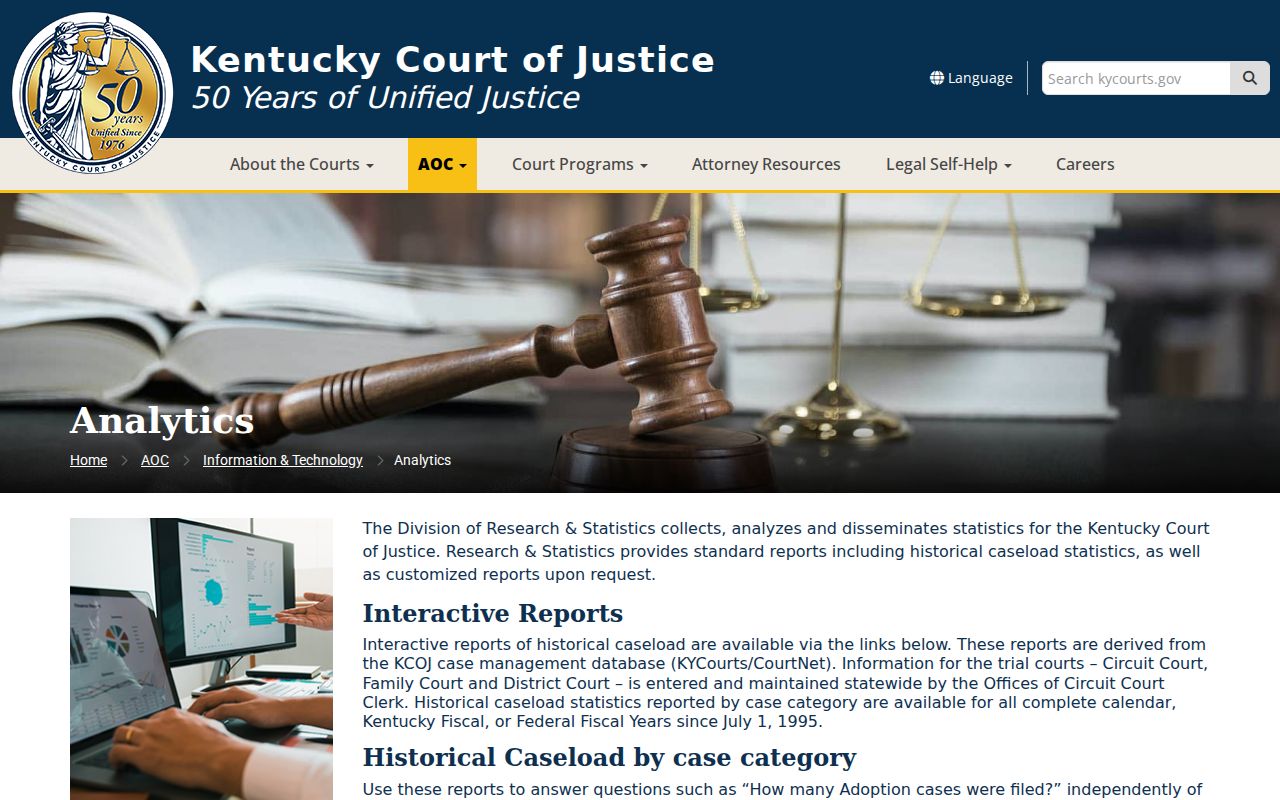
Analytics place Kentucky court activity in context, but a case question still belongs with Guest CourtNet and the filing county clerk.
Types of Kentucky Court Records
Circuit Court is Kentucky's general-jurisdiction trial court for felonies, civil claims over $5,000, divorce and other Family Court work, contested probate, and appeals from District Court. District Court handles misdemeanors, violations, traffic, preliminary felony matters, civil claims through $5,000, small claims through $2,500, eviction, guardianship, and uncontested probate. Family Court is a Circuit division where established, not a separate tier.
The elected Circuit Court Clerk manages Circuit, Family, and District records in each county. Kentucky's separately elected county clerk issues marriage licenses and records land instruments but does not keep divorce cases, felony judgments, traffic dockets, or probate pleadings. The filing county remains the practical route even when a circuit or district spans several counties.
- Circuit civil: complaints, answers, motions, admitted exhibits, orders, verdicts, judgments, liens, and appeals.
- District civil: small claims, eviction, service papers, hearing entries, judgments, and satisfaction records.
- Criminal and traffic: complaints, citations, indictments, pleas, bond, dispositions, sentences, payments, and appeals.
- Family: divorce, custody, support, adoption, protection, enforcement, and modification filings.
- Probate and guardianship: wills, appointments, inventories, claims, settlements, and public orders.
What Kentucky Court Records Show
A Kentucky court record begins with the county, court, division, full case number, type, filing date, parties, and current status. Its history can show a complaint or citation, service, arraignment, plea, motion, hearing, continuance, order, trial, judgment, sentence, appeal, remand, and closure. Criminal displays may add the charge, KRS citation, level, amendment, and separate outcome for each count. Financial or bond entries can appear, but a balance does not state the case outcome.
| Field | What It Shows |
|---|---|
| Case Number | Filing year, Kentucky case-type code, and sequence; preserve leading zeroes. |
| Filing Date | When the action entered that court, which can differ from arrest or judgment. |
| Parties | Plaintiff, Commonwealth, defendant, petitioner, respondent, counsel, and role. |
| Court / Division | District, Circuit, Family, or appellate venue and assigned division. |
| Status | Pending, active, disposed, reopened, transferred, stayed, sealed, or expunged. |
| Disposition | The result of each claim or charge, not merely the original allegation. |
| Schedule | Event type, date, time, location, courtroom, and judge where populated. |
| Documents | Docket entries or public images; an event line does not promise a download. |
Read a disposition charge by charge and in sequence. An allegation can be amended, and "disposed" can mean conviction, dismissal, acquittal, transfer, or another closure. The signed judgment or order controls when a summary and filed document differ. Transcripts and recordings may require a separate order and preparation charge.
Kentucky Court Records Access Rules
Kentucky judicial access rests on court rules and clerk custody as well as public-agency law. KRS 61.870 defines public agencies, records, and custodians. KRS 61.872 sets inspection and request mechanics. KRS 61.878 lists privacy, law-enforcement, and legally confidential exemptions. Judicial file requests use the clerk's case-copy process, not an AOC open-records request.
Ask to inspect a Kentucky court record before buying copies. State schedules set many filing categories, but page, certification, authentication, media, postage, service, facility, and card charges can vary. A plain copy reproduces a document. A certified copy adds the clerk's attestation and seal. An exemplified copy adds formal attestations for certain out-of-state uses. Confirm the product and estimate before paying.
Note: Certification proves that a Kentucky court record came from the official file, not that every allegation in it is true.
Restricted Kentucky Court Records
Public docket access does not open every page. KRS 610.340 protects juvenile records subject to listed exceptions. Adoption material, mental-health evaluations, disability records, protected addresses, Social Security numbers, account numbers, health data, and minor identifiers can be sealed, restricted, or redacted. A public no-result is not proof that no protected proceeding exists. Access may depend on party status, identity, consent, subpoena, statute, or court order.
Sealed cases are not viewable in CourtNet under Supreme Court Administrative Order 2024-17. Expungement is a legal process, not a request to hide a search result. A person first obtains an AOC certification, then files the correct petition with the Circuit Court Clerk in the county of the original charge. Eligibility and legal effect depend on the record and statute.
The judiciary's Guest CourtNet warnings and use limits also direct users to verify online event information with the official court record.
Kentucky Trial and Appellate Records
Guest CourtNet serves trial-court events. Supreme Court and Court of Appeals matters use C-Track Public Access, linked from the judiciary's request page. Appellate searches can use the appellate case number, party, attorney, lower-court number, filing range, or court. Results can show the caption, status, originating county, attorneys, event history, argument, and public opinions or orders.
An appeal creates another record without replacing the trial file. District appeals go to local Circuit Court. Circuit and Family final judgments generally go to the Kentucky Court of Appeals, while specified severe criminal sentences go directly to the Supreme Court. The appellate docket tracks notices, record assembly, briefs, motions, argument, opinion, mandate, and remand. The county clerk retains the source documents.
Federal litigation is separate. The assigned PACER Case Locator source searches federal cases nationwide.
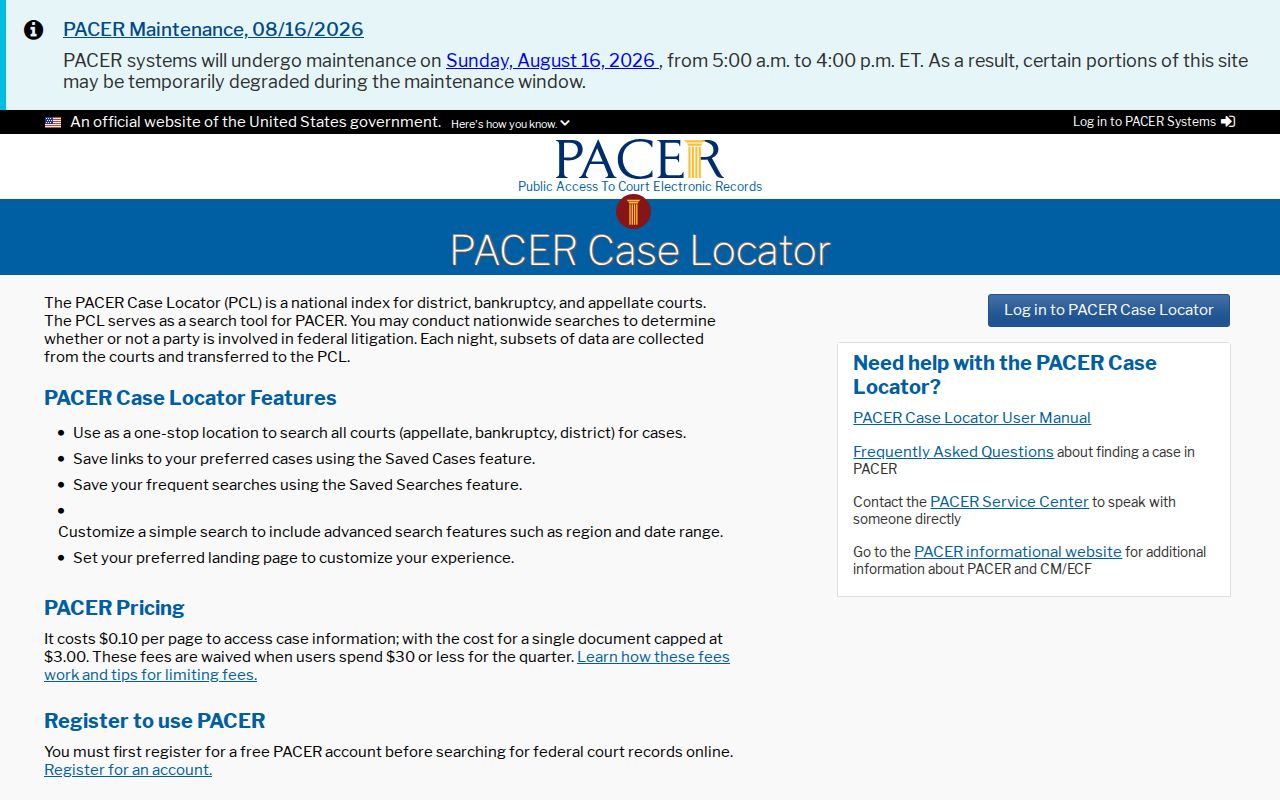
PACER does not contain ordinary Kentucky divorce, probate, traffic, or Commonwealth criminal cases. Free contributed federal docket material can be incomplete and is neither official nor certified.
Older Kentucky Court Records
Older Kentucky court records can be onsite, stored at a records facility, transferred to an archive, or destroyed under an approved retention schedule. Start with the filing county's Circuit Court Clerk. If a file is at the State Records Center, the clerk must provide both case and file-locator numbers. The center cannot search court files by name or Social Security number. Very old records may instead be held by the Kentucky Department for Libraries and Archives.
Ask for the smallest useful set of documents. A docket sheet may identify the signed judgment, order, will, decree, or appointment a recipient needs. For audio, video, exhibits, or a transcript, ask whether the item exists, its format and retention status, who prepares it, the estimate, and the deadline. Online summaries can outlast paper attachments, while old index entries may never have had a public image.
Find Kentucky Court Records Offices
Every Kentucky county has one Office of Circuit Court Clerk for Circuit, Family, and District files. Use the county directory to reach the filing county's local records site, and consult the Kentucky Circuit Court Clerks overview for statewide duties. Gather the full case number, party name, approximate year, court division, and exact document requested. Ask whether the record is onsite, archived, or appellate, then request a page count, copy type, accepted payment, and delivery method.
The Kentucky Court of Justice county selector provides official clerk contacts. Phone, mail, email, fax, hours, tender, and online options vary. The Circuit Court Clerk confirms court files, while the separate county clerk handles marriage licenses and land instruments.
Tip: Use the county printed in the case header, not a party's current address or the mailing city of a regional facility.