
Kentucky Criminal Case Files
A criminal court file answers what happened in one prosecution. Kentucky's elected Circuit Court Clerk keeps the official Circuit, Family, and District Court records for the filing county. The file can contain the complaint or citation, indictment, counsel appearances, bond orders, motions, hearing entries, plea, verdict, judgment, sentence, and appeal events. Police reports and jail bookings belong to other custodians. Readers focused on the accusation stage can review Kentucky arrest records and court charges, while this file supplies the court's full procedural history.
District Court receives misdemeanor and violation cases, traffic matters, and the preliminary phase of a felony. Those early felony files commonly carry an F case type. If a grand jury returns an indictment, Circuit Court opens a CR case. Both numbers may be needed. The Commonwealth's Attorney prosecutes felonies in Circuit Court, while county attorneys commonly handle District matters. A police recommendation is not a judicial ruling, and an indictment is not a conviction.
Search Kentucky Criminal Court Records
Guest CourtNet through KYeCourts provides statewide informational case data. Search by county and name, full case number, case type, or date tools available to the guest user. Common criminal numbers include M for misdemeanor, F for preliminary felony, and CR for Circuit criminal. CourtNet is a lead, not the certified file. Sealed cases and protected images do not appear to public guests, and recent entries can lag.
- Choose the likely filing county and search the legal name used at the time of the case. Add a first name only when needed to separate matches.
- Open likely results and compare county, court, birth information when lawfully displayed, charge date, and known events. A name match alone is weak proof.
- Record every case number. For a felony, look for both the District
Fmatter and any later CircuitCRprosecution. - Read original charges, amendments, count-level dispositions, judgment, and postjudgment events in time order.
- Use the Kentucky county directory to reach the Circuit Court Clerk and request the indictment, signed judgment, sentence, or certified copy.
For an older case, begin with the clerk even when no online result appears. The file may remain onsite, sit at the State Records Center, have moved to archives, or have been destroyed under a retention schedule. When the State Records Center holds it, the clerk must supply both the case number and file-locator number. The center cannot search court files by a person's name or Social Security number.
Ask for the precise product needed. A docket sheet summarizes events. A plain copy reproduces a document. A certified copy adds the clerk's seal and attestation, while an authenticated or exemplified copy may carry added formal certification for use outside Kentucky. Transcripts are prepared through a separate process and can require an estimate or deposit. Certification proves the copy came from the record; it does not prove that every allegation in a complaint or motion is true.
Kentucky Criminal Case Stages
Each stage leaves a different record. A citation or complaint begins the District phase. Arraignment identifies the charge, counsel, plea when appropriate, and release terms. Felony evidence may go to a grand jury. An indictment then creates a Circuit prosecution. Discovery may occur without every item being filed, but motions, hearings, and orders appear on the docket. The signed judgment controls after a plea or trial.
Case flow: Charges Filed › Arraignment › Pretrial / Motions › Plea or Trial › Disposition › Sentencing
- Arraignment
- The court states charges, addresses counsel and release, receives the allowed plea, and sets the next event.
- Pretrial and motions
- Discovery orders, suppression, competency, bond review, continuances, and plea talks create docket events or written orders.
- Plea or trial
- A plea colloquy, jury or bench trial, verdict, dismissal, or acquittal resolves each count differently.
- Sentencing
- The judgment may state custody, concurrent or consecutive terms, probation, credit, fines, costs, restitution, and conditions.
What Kentucky Criminal Records Show
Start with the header, then read the event list. The county, court, number, and party must match before any outcome is attributed. One case can contain several counts with different amendments and results. A docket line shows that an event occurred, but it does not replace the filed document. Public image access varies, so order the signed order when exact wording matters.
| Field | What It Shows |
|---|---|
| Case Number | Filing year, case-type code, and sequence, plus the county and District or Circuit division. |
| Defendant | Name, role, counsel, and limited identifiers used to distinguish the person. |
| Charges | Count, offense text, KRS citation, class, filing date, and original-to-amended history. |
| Plea | The response entered for each count and any later change accepted by the court. |
| Disposition | Dismissal, acquittal, conviction, diversion, transfer, or other count-level outcome and date. |
| Sentence | Custody, probation, credit, fines, costs, restitution, conditions, and later revocation or appeal events. |
Kentucky Charges vs. Convictions
A charge is an accusation. A conviction is an adjudication of guilt by accepted plea or verdict. Kentucky records may show an original felony that was reduced, a count dismissed while another ended in conviction, or an acquittal after trial. Report the final disposition for each count. The word “disposed” only says processing ended; it does not mean guilty.
| Charge | Conviction | |
|---|---|---|
| Stage | Accusation | Verdict or plea |
| Burden of Proof | Probable cause | Beyond reasonable doubt |
| Proof to Obtain | Filed complaint, citation, or indictment | Signed judgment and sentence |
Read Kentucky Criminal Outcomes
Read the chronology in five passes: original charge, amendments, plea or verdict, disposition, and signed judgment. Then check probation, revocation, appeal, remand, modification, or expungement entries. Dismissed with prejudice ordinarily bars the same charge from being filed again, while a dismissal without prejudice does not. “Nolle prosequi” records a prosecutor's choice not to continue at that time. Diversion or conditional dismissal is not automatically expungement.
Sentence arithmetic can also mislead. Concurrent terms run together, while consecutive terms run one after another, subject to the judgment and law. Jail credit, suspended or probated portions, later revocation, and new sentences can alter custody. The court file states the sentence imposed. The Department of Corrections administers release projections, which may change.
Note: A zero balance concerns displayed money entries and does not prove that a Kentucky criminal charge was dismissed.
Kentucky Sealed vs. Expunged Records
Sealed cases are excluded from public CourtNet access under Supreme Court Administrative Order 2024-17. Expungement is a separate statutory process. A requester first obtains an expungement certification, then files the correct petition with the Circuit Court Clerk in the county of the original charge. Eligibility depends on the offense, outcome, waiting period, completion, and current law.
| Sealed | Expunged | |
|---|---|---|
| Public visibility | Not supported or viewable in public CourtNet | Eligible official records are removed as the order directs |
| How it occurs | By law or court order | Certification, petition, review, order, and required payment |
| Kentucky limit | Authorized access may still exist | Only cases eligible under statutes such as KRS 431.073 qualify |
Kentucky Criminal Record Access
Judicial rules and clerk practice govern court-case access, while Kentucky's Open Records Act governs many agency records. Identify the custodian before sending a request. The Circuit Court Clerk is the custodian for county criminal case files. Police, jail, prosecutor, KSP, and AOC records have different scopes and exemptions. Ask for an existing, named document and whether a redacted copy can be released if part is protected.
Key Statutes:
KRS 61.870 defines public agencies, records, and official custodians.
KRS 61.878 lists privacy, law-enforcement, and other statutory exemptions.
Kentucky Statewide Criminal Reports
The AOC criminal record report searches CourtNet activity in all 120 counties for T, M, F, and CR case types. It can report county, case number, original charge, amendment, disposition, dates, and clerk memos. Yet AOC stamps it “Not an Official Court Record.” It is a compiled court-data product, not a judge-signed indictment, judgment, or order.
The Kentucky State Police criminal-history program is a separate repository and fingerprint channel. Name-based and fingerprint-based products differ by statutory purpose, consent, identity assurance, and possible FBI component. Employers and licensing bodies must select the authorized product rather than use Guest CourtNet, whose public terms bar employment, licensing, and government-benefit eligibility use.
The official AOC report page shows Kentucky's statewide court-based product and its limits.
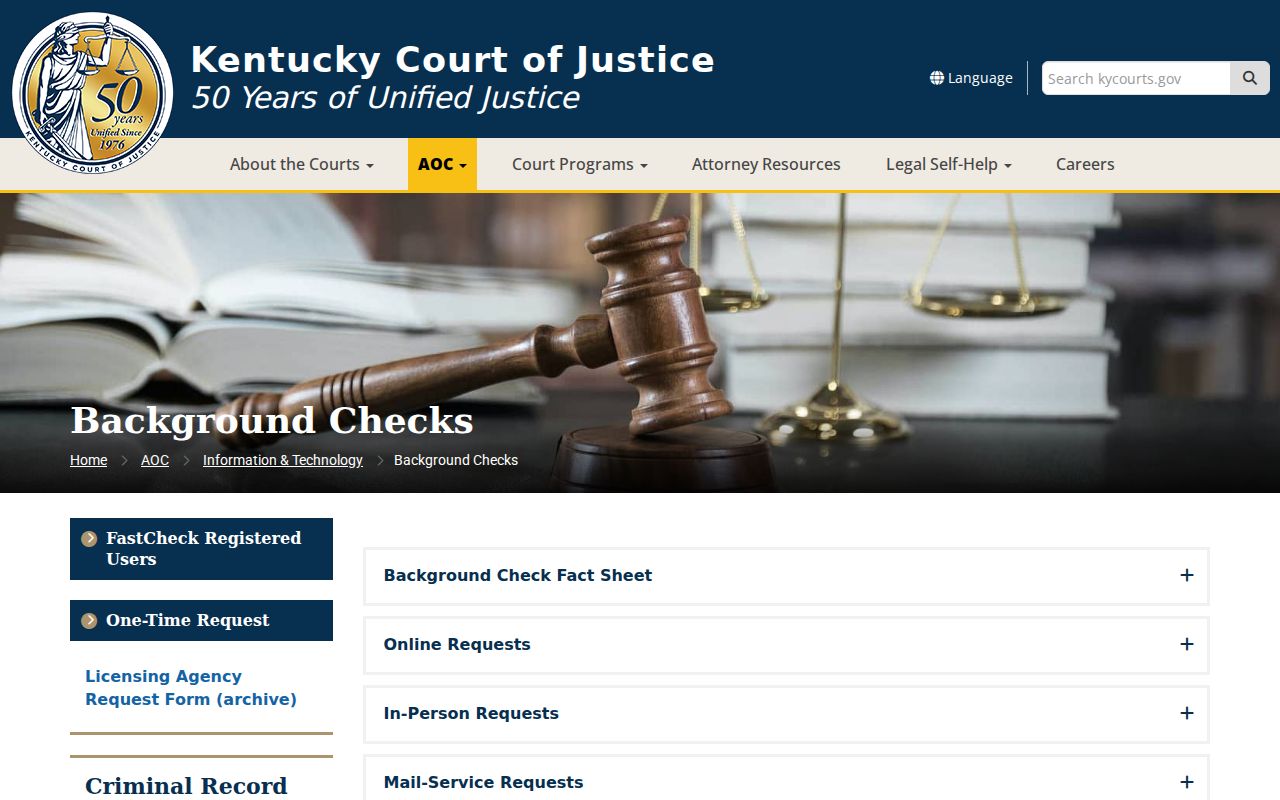
The report helps locate county cases, but the filing county's clerk remains the source for certified proof.
Important: This private resource is not a consumer reporting agency, and its content may not support employment, credit, housing, or insurance decisions.
Restricted Kentucky Criminal Records
KRS 610.340 restricts juvenile records. Adoption, mental-health, and disability files also receive special protection. Clerks redact Social Security numbers, account data, minor identifiers, health information, and protected addresses. Grand-jury deliberations and much supporting material remain secret even when an indictment is public. Active investigative records may be withheld by the agency custodian, and an open-records request cannot override a seal.
A public no-result therefore has several possible meanings. The record may be confidential, sealed, expunged, delayed, archived, or filed under another county or number. It does not prove no case exists. For legal proof, identify the county and obtain the narrow official document needed. Certification proves that the copy came from the clerk's record; it does not make every allegation in a pleading true.
Note: Search every known Kentucky case number after transfer, indictment, reopening, or appeal because each stage may create a linked record.